Showing posts with label writing. Show all posts

Saturday, June 30, 2018

An Invitation...


If you are a dreamer, come in
If you are a dreamer, a wisher, a liar,
A hope-er, a pray-er, a magic bean buyer...
If you're a pretender, come sit by the fire
For we have some flax-golden tales to spin.
Come in!
Come in! 
The Writing Project experience is one I look forward to every year. This institute is always a huge blessing to me an an educator. A coming home after a school year filled with plans, goals, and commitments. For me, the Central Texas Writing Project is:

And ending and a beginning
A finish and a start
An accomplishment and a goal
It’s graphite and eraser
It’s student and teacher
It’s sense of urgency and laid back
It’s the reason and the outcome
The hope and the promise


The day before our last day together, we went as a group to watch the documentary about Mr. Roger’s career and the mark he left on the children’s programming industry. We were reminded of the icon’s passions for communication, reverence for children, inclusivity, and kindness. The Mr. Rogers movie ended the way the writing project began: with an invitation.

An invitation to notice
An invitation to wonder
An invitation to question
And what we are now extending you you...An invitation to write.

Teacher writers,
  • Angel
  • Veronica
  • Julie
  • Brittany
  • Megan
  • Zach

at the beginning of this institute, you weren’t comfortable with the title, “writer,” but you have engaged in a writing battle. You have been vulnerable, exposed, and validated for the ideas you have and how you will implement them in your classrooms. You will now (as Mem Fox says) have empathy for the comrades in your classrooms who must learn to fight this writing battle for themselves. May your summer be filled with rest and relaxation, with time to reflect on what you want to cling to tightly and practices you are willing to let go.

I am so proud to have been with you on this journey and I look forward to hearing stories of how you are changing the world.

Wednesday, June 28, 2017

Wonder Woman and What it Means for Educators

Today, as our time at the Central Texas Writing Project drew to a close, we chose to go see Wonder Woman in San Marcos. I'm typically not a super-hero-movie kind of girl, but this group of teacher-writers has come to mean so much to me this summer, that I jumped at the opportunity to extend our time together.

Please keep in mind- I know ZERO about Wonder Woman. I think she was in comic books, I know I used to have Wonder Woman Underoos as a small child because I can remember the gold cardboard tiara and arm cuffs. I believe she fits in with a larger picture of super heroes because there was a preview of the Justice League before the movie started and I think she was in it. I don't really know, and it's frankly not relevant to my reflections, but I wanted to make it crystal clear that I am not an authority on Wonder Woman. I looked on Wikipedia for some background on her and my eyes glazed over by paragraph two of 1, 465, 373. It's fine.  Image credit
I kept wishing I could get out my phone and take notes about ideas and quotes that were special to me during the movie. The Writing Project and #BookSnaps have me in such a journaling, annotating mindset that I feel sure I will have to see this movie 100 more times before I feel satisfied that I have expressed all the connections that are in my mind. So, what exactly, does Wonder Woman mean for educators?

1. Wonder Woman had a rag-tag team that had her back. 
Diana and Steve assembled a crew that had unique qualities and varied skill-sets. Sameer, Charlie, and The Chief had special reasons that Steve asked them to join their crusade. This is how the best teachers operate. They find a tribe. They find other educators who will support, challenge, build-up, and do life together. The most effective teachers do not feel like they are in competition with their colleagues, but view these most important people as a community of learners. They joke with each other at lunch, they hold each other's babies, and they talk about standards, students, and finding a better way. They know they can count on each other, just as Wonder Woman knew that her supporters were there for her.
2. Wonder Woman had a small arsenal of highly-effective tools.
She did not need one thousand different weapons; she needed a few that she knew how to use well. She wielded a sword, a shield, powerful bracelets, a tiara, and that interesting light up rope thing. She used them flexibly, confidently brandishing the tool she needed when she knew it would be the most effective. Teachers are bombarded with tools, books, strategies, and images of darling classrooms with near-perfect lighting and precious decorations. It can feel dangerous to walk through the fire, shrapnel, and noise of best practice, innovative ideas, and do not get me started on Pinterest. The most effective teachers do not try to do it all. They may try out the latest thing, but if it does not fit their need and their kids, they will go back to what does. They will brandish what kids need when they need it, and move skillfully back and forth between innovation, reality, and common sense.

3. Wonder Woman saw people.
She saw the people she loved and she saw strangers. She saw babies and children and poor villagers and wounded war veterans. She gave her attention to the people who could help her and the people who could not. She was a voice for the voiceless, a power for the powerless. She felt deeply, was not afraid of her emotions, and channeled brief feelings of fear and uncertainty into a fire that fueled her fight. Instead of needing a hero like Bonnie Tyler, she became the hero, bringing hope and peace to a fallen world. One of my favorite scenes is when she eats ice cream for the first time. Steve is trying to hurry her up, and she looks at the vendor closely and says, "It's wonderful. You should be very proud." The most effective teachers see people. They see students and colleagues and parents and children in the world. They see the power in the role they have chosen. They can turn feelings of sadness and worry into a fire that fuels the work they do with children and young adults. They listen to the WHY that is behind the words, behind the behavior, behind the silence. They notice if a kid is not himself, if a parent needs an explanation, or if a colleague needs a friend.
As an Instructional Coach, my lens of education has broadened a bit. My mind was exactly where it needed to be when I was in the classroom, but coaching brings a new job description, a new focus, and a new clientele. My job as a classroom teacher was to be focused on my students, but my job as a coach requires me to focus on teachers...so they can focus on students. My ultimate goal is to improve student outcomes, whether those are academic, relational, emotional, or physical.

Wonder Woman has challenged me: I have assembled an eclectic group of educators who are cheering me on. If I need help, I can ask my people: those I know in person and those I know online. I have some highly effective tools that enhance the work I do each day. I write to reflect, I talk to understand, and I utilize technology to enhance and proclaim the messages I want to put out in the world. I try to see people. I see children in the building where I work, I see my family letting me be who I am, I see teachers working themselves to exhaustion to find better ways to reach children.

Steve tells Wonder Woman, 

'My father told me once, he said, "If you see something wrong happening in the world, you can either do nothing, or you can do something". And I already tried nothing.'




Thursday, June 8, 2017

Joy Write

Lucky me! I am back working at the Central Texas Writing Project. CTWP is a month-long institute that is dedicated to developing Teacher Consultants through research, writing, and demonstrations. Each summer, teachers from central Texas gather at Texas State University to learn from each other and develop a confidence for teaching writing that can only come from writing themselves.


Each participant gets to choose a book that will help him/her on the path to developing a demonstration. I had the opportunity to share about the book Joy Write by Ralph Fletcher. I highly recommend this book to anyone who has lost that lovin' feeling about teaching writing.
As I read through this book, I was immediately drawn to the motivation aspect of its message. This is not a book about programs, curriculum, or standards, although those certainly can help us reach goals for our students. The premise of this book is to help students and teachers understand the joy that can be found in writing and the idea of play that surrounds the writing process. 

                                      
What can we do as educators to ensure our kids discover the joy in writing? How can we capitalize on the enthusiasm and tools of our students to increase motivation, engagement, and creation? How might we infuse our writing instruction with wonder, quirkiness, and passion?
                                      

Please read this book, and share success stories below!

Monday, May 8, 2017

A Day in the Life of the Writing Project...

It's almost time for the Central Texas Writing Project! Last weekend, a group of teachers, professors, and authors gathered at Texas State University for our first pre-institute meeting. We gathered to share food, make introductions, and learn a bit about how the Writing Project works.
                                                "my mom holds her accent like a shotgun, 
                                                 with two good hands. 
                                                 her tongue, all brass knuckle 
                                                 slipping in between her lips
                                                 her hips, all laughter and wind clap."


The day began with a poem by Denice Frohman. Her poem, "Accents," set the stage for our journal writing time. After we had several minutes to write, we opened up the floor and got to hear from several brave teachers. Participants used Denice's poem as a springboard that turned into stories about their mothers, words they remember from childhood, stories of pain and strength, and the love of a family. Author's chair is one of the most special parts of any writer's workshop, and especially of the Writing Project.


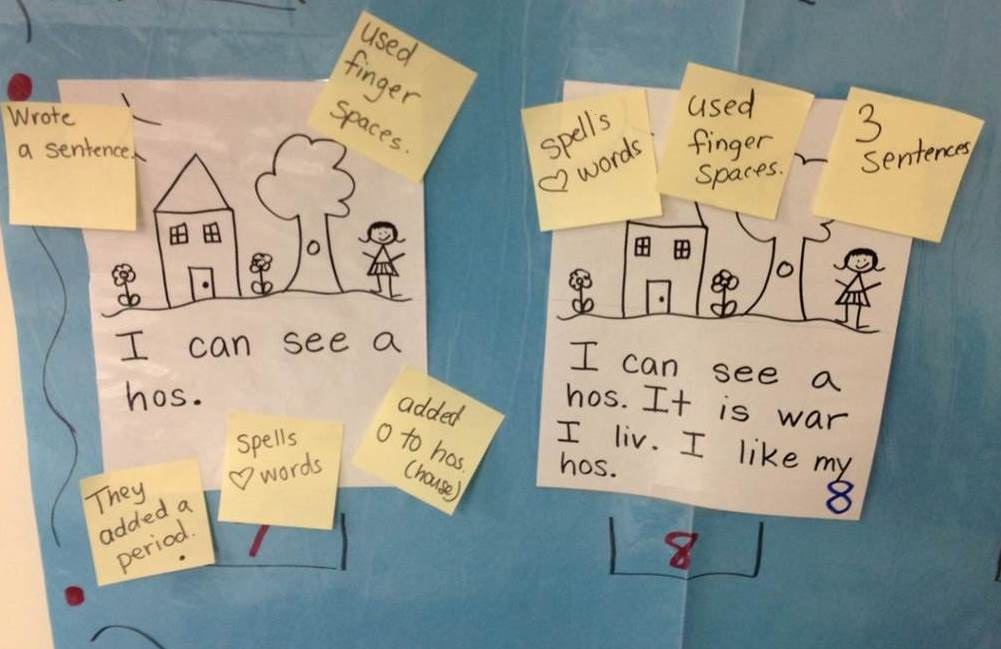
Next, I got the opportunity to model a demonstration based on the book A Squiggly Story by Andrew Larsen. I've blogged previously about this gem of a book. We focused on kindergarten writing goals, invented spelling, and how important student ownership is in the writing process. The teachers put themselves in the place of 5 & 6 year old writers and practiced writing from a student point of view.


During lunchtime, the teachers met with their coaches to work on preparing the demonstration lessons that will be presented during the Writing Project. This time allows the future teacher consultants to match their classroom practice with behavior and education theory. They get an alternative viewpoint, a new mentor, and the encouragement of someone who has been through the Writing Project experience before.

We ended the day much the way it began. We watched a brief video on the What's Your Sentence project by Dan Pink.
After the video, we all reflected on the day, the video, and wrote our sentence. We shared our sentences around a circle, with bold statements about the teachers, men, women, and people we wanted to be. We wrote of how we want to be remembered, who we want to influence, and the children we hope to affect.

If you ever want to be a part of a professional development experience that will change your life, please look into a local Writing Project site. I cannot wait to get started!

Friday, February 3, 2017

A Squiggly Story

One of the things I miss most about the classroom is reading to children. There is such power in telling a story well, and read-alouds afforded me the opportunity to use all those skills I learned in high school speech and performance classes. An enjoyment of reading, paired with a well-written children's book can set the stage for a host of learning opportunities, as well as (and equally as important) provide a warm, special experience between a teacher and her class.

Read-alouds build classroom community, provide common experiences, provide models for fluency and comprehension, and are just plain fun. Reading Magic by Mem Fox is one of my favorite books for adults that sheds light on the importance of read-alouds. In it, she talks about the classroom read-aloud and how it's ultimate design is to mimic the loving shared reading experience between a child and parent. Over my years as a classroom teacher, I've accidentally been called, "Mom," over a hundred times, and I truly do believe in the power of books that are read aloud by a trusted adult.

Every so often, a read-aloud comes along that makes me ache to have my own classroom again. A Squiggly Story by Andrew Larsen did just that. It came up in my Amazon list of books I should (of course) want to buy and I fell in love with the believable story line, the darling illustrations by Mike Lowery, and the myriad classroom implications. As the co-director of the Central Texas Writing Project, I am always on the hunt for books that highlight and celebrate the writing process of children who are not yet writing conventionally. This book is now one of my very favorites, and I cannot wait to share it with teachers this summer.

I borrowed a kindergarten class at the campus where I am the instructional coach so I would have a chance to try this book out with real children. After reading A Squiggly Story (which the kids LOVED by the way), we brainstormed a list of things that the kids may want to write about. In the book, the main character's older says, "It's easy, just write what you know." During this time, I modeled stretching out words and spelling phonetically since kindergartners often get hung up on writing because they want you to tell them how to spell everything.

I am so thankful I work with teachers who open up their classrooms and share their learners with me. 
I had such a fantastic time in kindergarten this week! 

Saturday, September 3, 2016

Writer's Workshop: The Power of the Pencil

"And above all, watch with glittering eyes the whole world around you because the greatest secrets are always hidden in the most unlikely places. Those who don't believe in magic will never find it." — Roald Dahl

As an elementary teacher and instructional coach, one of the things I have heard over and over is how overwhelming it is for teachers to set up a Writer’s Workshop.  This structure, researched by many, including Donald Graves, Donald Murray, and Lucy Calkins, provides students with a predictable routine for writing instruction that includes a mini-lesson and extended time for students to write. During the workshop time, the teacher will confer with individuals and small groups and the students will spend time prewriting, drafting, editing, revising, and publishing.

One of the most important things for teachers to understand is that Writer’s Workshop is not WHAT you teach, it is the framework that is in place for the writing block. Once students understand the predictable structure of this sacred time, the teacher will utilize district curriculum and pacing guides, state standards, and the needs of students to dictate what is taught in mini-lessons. Teachers may utilize mentor texts, model writing in front of children, pair students for peer-editing and revision, and provide varied opportunities for publishing.


Structure of a Writer’s Workshop
Mini-lesson (about 15 minutes)
*Focused lesson on a single topic usually taken from your state standards or district curriculum
*Adjust for the needs of your students
*May include examining a mentor text or teacher modeling
Writing time (20-45 minutes*)
*Students write
*Kids may work individually and/or partnerships
*Teacher will confer with individuals or may pull small groups that need targeted writing instruction
*Students may also be working on different stages of the writing process during this time: drafting, editing, revising, publishing, etc.
Sharing/Wrap-up (5-10 minutes)
*Students may share writing in partners, groups, or with the entire class
*Teacher may share writing
*Reiterate teaching point from mini-lesson
*Depending on your students

There are many resources for setting up this time, but teachers should utilize the following components to ensure the most effective environment for a daily writing routine.

P-E-N-C-I-L
Purpose: Above all, children need authentic reasons to write. When kids know their writing will be viewed by their classmates, others in their school, and even online, they have an innate desire to do their best because they know it is not just busy work. When teachers present writing lessons, they can build on kids’ unique experiences, their hopes and dreams, and their questions to spark purposeful reasons to write. Patricia Cunningham and Richard Allington say, “Children who are successful at becoming literate view reading and writing as authentic activities from which they get information and pleasure, and by which they communicate with others.”
kinder.jpg


Environment: Intentional teachers will set up a classroom environment that supports independence and literacy connections to daily life, grade-level content, and authentic writing opportunities. Children should be surrounded by meaningful labels, charts, and literature from a broad range of genres. This access should include print books and technology resources and should reflect a developmentally appropriate range of literacy opportunities. A first grade print-rich environment will differ tremendously from that of a sophomore English class, but both teachers will think through ways to establish an environment that is engaging and mirrors their students’ real lives as readers and authors. As students are introduced to new types of writing, multiple examples of mentor texts that support the structure should be available for kids to read and emulate. For further examples of literacy-rich environments, click here.
IMG_7023.jpg


Nurture: In college, I read a book by Mem Fox that changed the trajectory of my thoughts as a teacher and a writer. In her book Radical Reflections, Fox writes, “I think we tend to forget about this element of relationships when we teach writing. Are we aware of how much our students dread having their writing knocked back? Do we trample on their vulnerability when they limp in, unarmed, from the battlefield? It’s hard to keep in mind the painful wounds of battle and the importance of friendship unless you’ve been wounded yourself. Teachers of writing who have been soldiers themselves, engaged in a writing battle, must be able to empathize more closely with the comrades in their classrooms than teachers who are merely war correspondents at the hotel bar, as it were, watching the battle from a safe distance, declining to get in there themselves and write.”


This quote changed me. As a teacher consultant for the Central Texas Writing Project and an elementary classroom teacher, I have been able to see first-hand how powerful it is when a teacher writes alongside his/her students. It communicates camaraderie and understanding. It shows student writers that the teacher is willing to be vulnerable and engage in a writing struggle. It requires teachers to look for supportive and nurturing ways to provide targeted feedback to students that will improve writing instruction and ultimately, student performance. The definition of the word nurture is, “To care for and encourage the growth or development of…” This clearly doesn’t mean we are always sunshiny and never hold students accountable for growth and grammar. It means that we meet each student writer where they are and find targeted ways to help them develop into accomplished, capable authors.


Coach: Writing development doesn’t just happen. Intentional teachers will observe their students in order to look for what kids already do well and what they need today to be a better writer tomorrow. Building on those individual strengths helps children at all stages of writing development grow as authors. If a group of students needs work on a similar writing goal the teacher may decide to pull a small group for a quick review of a particular skill. An advanced writer may need a gentle nudge from a teacher to discover a new writing technique, to find ways to add details to their writing, or be explicitly taught how to use a rubric to self-monitor their own writing. Coaching can be done by the teacher and also by the students, once proper expectations are in place. Click here for a student-made video about peer conferencing.


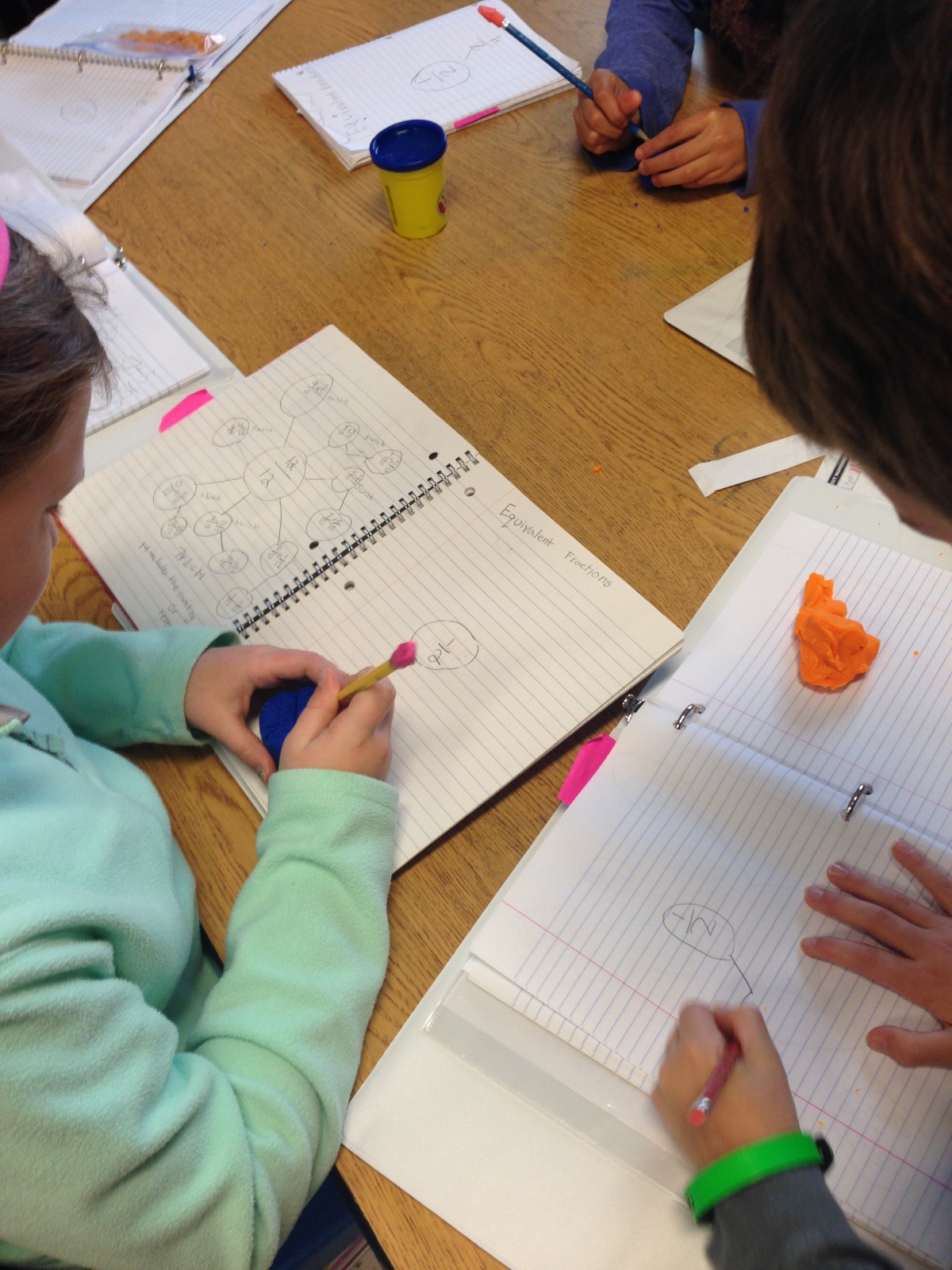
Integrated: It is my hope that time will be devoted to Writer’s Workshop each day, but it is crucial that the writing process be integrated into all aspects of the school experience. Writing skills may be taught in isolation, but will be transferred more naturally if they are woven into the daily fabric of math, reading, technology, science, and social studies instruction. Students may write to solidify scientific understandings and write to publish articles about important social studies figures. They may write a blog to explain connections with popular literature and to share books with peers. Technology should be leveraged to give students an authentic audience to share their work across the campus, the district, and the country. Today’s educational culture is shifting toward student choice, maker opportunities, and collaboration. Writer’s Workshop is a necessary complement to this kind of teaching, and should be celebrated as a way to reflect and connect student ideas and learning across content areas. For practical ideas about Writer’s Workshop and Makerspaces, click here.


Linked to Life: Want to know a secret? Kids are smart. It takes the average 7 year-old and 7th grader about 7 seconds to realize that a teacher has asked him/her to do busy work. In today’s society, kids are desperate for connection. Educators must find ways to use this need to our advantage and to improve student self-esteem and student performance in the process. Is there an issue that students care about? Write letters and deliver them instead of writing fake letters and hanging them in the hall. Do the kids see something in the library or their school they like or wonder about? Have them write notes to the students and teachers in other grades and ask questions. Do they need to ask for clarification, broaden their understanding of a topic, or disagree about something? Writing is the way that this generation of students communicates with peers and a broad global audience. Our online presence is strengthened when we write well, connect with others, and pay attention to spelling, grammar, and appropriate content. All of these skills are necessary and can be taught in the context of real-life applications of content in a caring classroom environment.


The PENCIL may seem to have lost some of its power in this age of technology. Whether students wield a Ticonderoga, a Chromebook, or an iPhone as their tool, the power they have as authors has never been more real. Brave teachers will find authentic, meaningful ways to hold on to the fundamentals of sound writing instruction as they navigate an evolving culture of technology application and worthwhile writing opportunities for all students.


Tuesday, June 16, 2015

Who am I, if not a Teacher?


This is first day fake. My desk only looked like that for 13 minutes.


I am a teacher. It is not just what I do, it is who I am. I gather books and resources all summer long, I write student names on desk tags and bulletin boards and folders and notebooks. I read reports, I input grades, I make phone calls, I pour my heart and soul into twenty two lives a year. I carefully watch for what students will not show, I listen closely to what students will not say, and I love. I love on those kids so hard that when our time together is finished, I am emotionally depleted, mentally exhausted, but wholly satisfied that the way I have chosen to spend my days, my months, my years...has mattered.


“You’re such a natural teacher,” people say.


No. It’s not natural. Intentional, maybe. Pre-ordained, possibly. But, in no way is this career choice, “natural.” To choose minds over money. Fulfillment over power. Disrespect over accolades. It is not easy to neglect your own children for those belonging to other people. It is not normal to go to work sick because there are not enough substitutes. It is not natural to spend your own money to buy books or use your vacation money to go to professional training because you know it will benefit your students, but the system does not have the money to send you.


Dave Burgess, author of, “Teach Like a Pirate,” says,
“I’ve worked my butt off to build a class that is outrageously engaging, fun, educationally sound, and dearly loved by students. It wasn’t easy when I started, it wasn’t easy last week, and it won’t be easy next week either. It’s not supposed to be easy–it’s supposed to be worth it. You can build something incredible if you put the effort in on the front end, and then keep putting the effort in until you turn the lights off and close your door for the last time. But it won’t be, “easy.”
So then, what if I have turned the lights off and closed the door for the last time? I have accepted a new position as an instructional coach, which means I will work with teachers, but I will not have my own classroom of kids. I will still have lights. I think I will still have a door. But who am I if I no longer have a class of twenty two babies wearing my name on the back of their class T-shirts? What is my purpose if I am not at my classroom door each morning, welcoming children, asking about baseball games and dance recitals, calming worried parents or consoling kids who had a rough morning? Will my work still matter if I cannot easily point to a moment when I was there the first time a child found a book they loved or used manners when they asked for something, or found a calm way to disagree with a peer? What about on field day during tug-of-war? Somebody hold me.
I mean, seriously.


As I transition into a new position, a new career, a new role, I find myself with more questions than answers. I am more nervous than self-assured. Let’s just be real- I am actually scared to death. Even though teaching has never been, “easy,” it has provided me with things I have come to value: structure, routine, predictability, a reason to buy school supplies…


For now, I am enjoying working with the Central Texas Writing Project at Texas State University, where my summer days are spent in professional development sessions, journal writing, participating in demonstration lessons presented by committed, brave teachers who are putting the needs of themselves and their students at the forefront. I am presenting, reading books, having collegial conversations, eating all kinds of naughty foods, and laughing about this ridiculous job that I love.
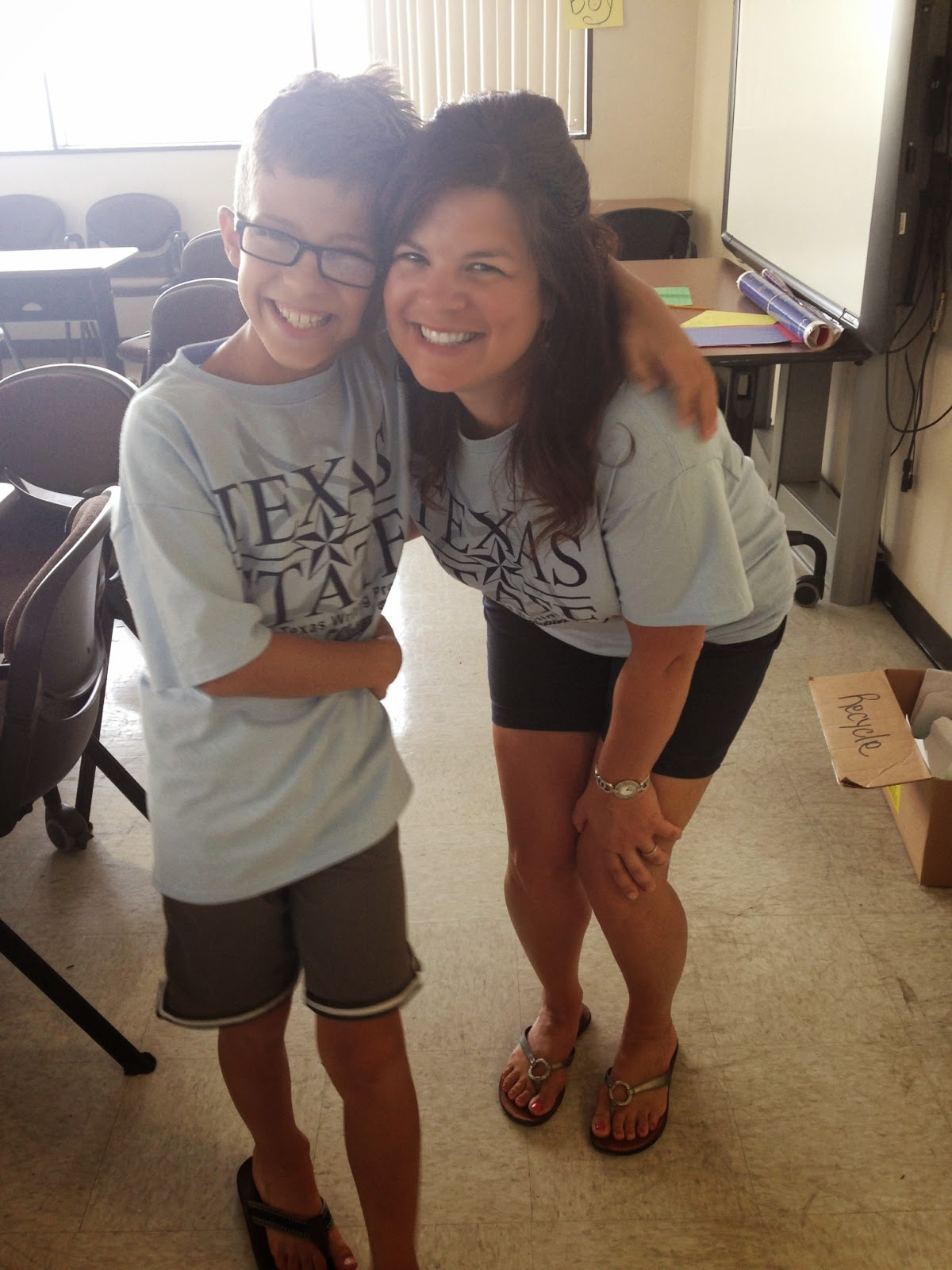
Mayson and I (One of my former third graders)

But when August comes, and you see me wandering around in the school supply aisle at Target, or through the halls at Back-to-School night, please avoid direct eye contact. You can smile and shoulder-pat, even ask how my summer went or where the 4th grade hall is located. But, please do not let your gaze linger...because if you really look closely, you will see a teacher without a class who will be desperately searching for her place in this world.

Wednesday, July 9, 2014

Writing Camp Saved My Life

That title may seem strongly worded. Please indulge me, as I have just come off of nine days working with young writers. Also, I like hyperbole. Also, I wanted to get your attention.

I suppose I wasn't really dying before, but it is hard to deny that strange sense of loss that teachers go through when school is out. Don't misunderstand...I LOVE SUMMER. I enjoy taking these yahoos bowling.
I enjoy the pool and the lazy mornings and the visits with friends and the summer techno music and the reading of books...but I would be a big, fat liar if I said I didn't miss teaching. I am a teacher. It's who I am. It's what I do. It's a huge part of my identity and a lot of my purpose as a human being on planet Earth is as, "Mrs. Taylor." It's the hugs at the door in the morning and sharing books with reluctant readers. It is trying to make lessons fun and engaging, it's finding the balance of teaching standards, spelling words, character, and multiplication strategies. I'm a big dork, but I love summer for about three to four weeks, and then I feel that weird pull...the tug of setting up my classroom, choosing just-right books that I think my students will enjoy, and the constant hope that this upcoming year...I'll finally get it right.

However...teaching is hard. Not just the oh-I'm-so-overworked-and-underpaid-and-my-raise-doesn't-even-cover-the-increase-in-health-insurance-kind-of-hard, but the real kind of hard. The kind of hard that makes me wonder if there is something more out there for me. Something bigger, something more productive, something more financially rewarding. They keep changing the game, changing the standards, changing the resources, changing the levels of support, and I find myself getting tired. So.Very.Tired. Just let me teach! Just let me do what I was born to do! Just...wait-I'm in public education...

Enter writing camp. I was approached this spring about teaching a writing camp at our local university and my first inclination was to giggle. Writing camp? Is that a joke? Who would pay money to send their child to write for three hours a day? In the SUMMER?  Apparently, several people.

"What's the curriculum?" I asked...
"Whatever you want it to be," I was told.

Wait. One. Second. I get to be the boss of how we spend the time? I can read fun, engaging stories and roll with the kids and their ideas? Yes, yes you do...

Holy Ticonderoga Number 2 pencils.
Oh, and you get paid.

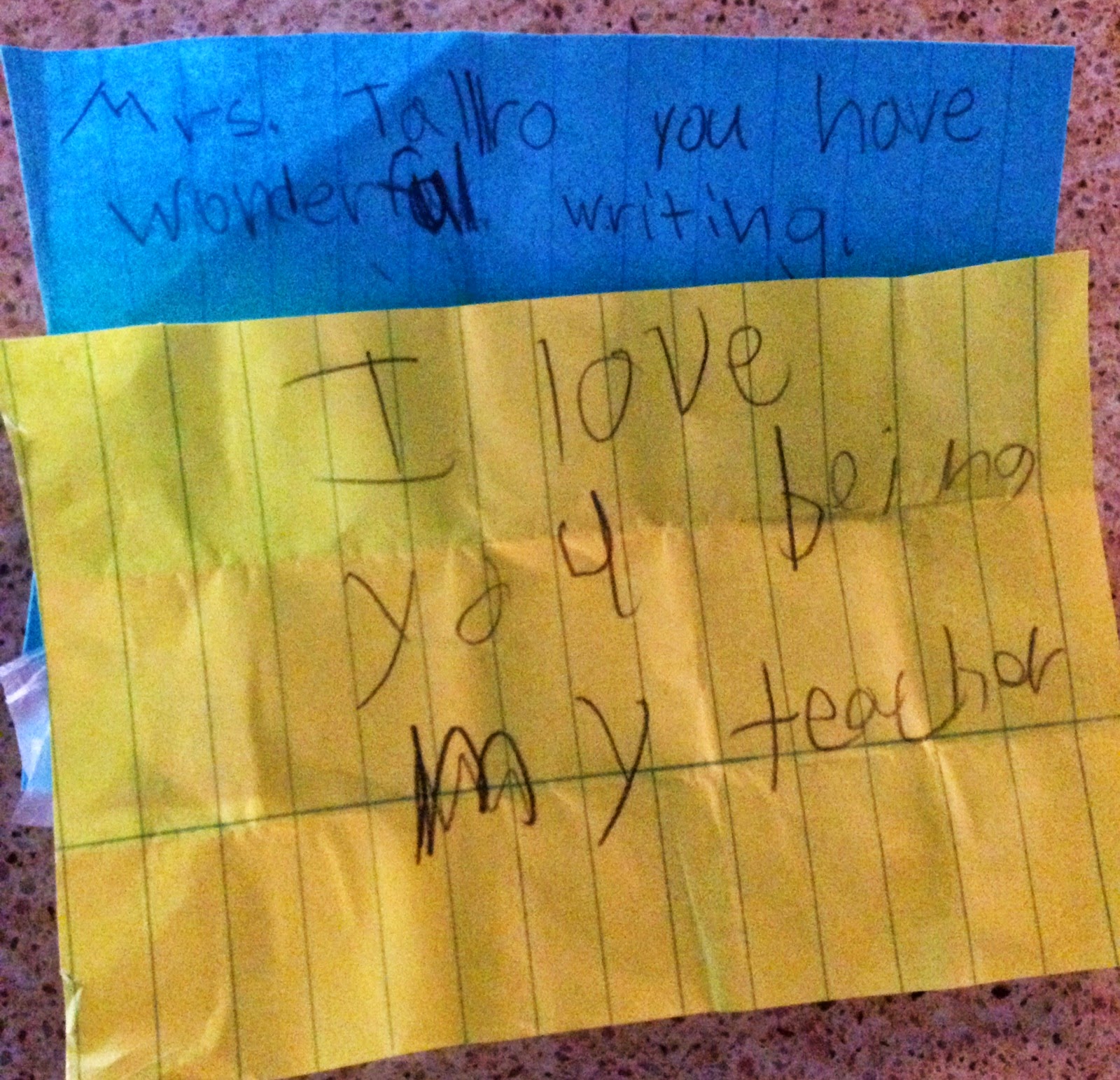
Writing camp saved my life. OK, maybe not my real, actual life, but it saved my summer. It saved me from that weird, unfulfilled feeling I sometimes feel in early July. I was put back together each day as kiddos that ranged in age from 5-10 years old worked in the same classroom and did the hard work of writing and sharing their thoughts and feelings. It re-energized me to hear the older kids support the younger writers with encouraging words and precious little "love notes."


 It reminded me of true collaboration as I met Laura at Starbucks and we shared ideas and we worked together and we already signed up to teach again next year because it was just so stinking fun. It reminded me of who I am at my very core and why I do what I do and how I can trust myself to go with my instincts and find new, engaging ways to bring the fun of writing camp into my own classroom in the fall. It made me want to write more. Even if nobody reads what I write. It made me have to reset the password on this blog that I started in 2011 and then never did anything else with...

It also gave me the rare opportunity to have my very own child in my class. I asked both of my kids if they wanted to come to camp with me. My seven year old was like, "Um, go to writing class or play at Nanny's house? You can just tell me what it's like." Parker, though, was excited about coming with me because he needed to work on his novel. Um, what?

"I've got this idea, mom. I just don't have much time to work on it."

Punkin. What fun to see him as a student and a writer and a leader. He even got to touch the sword from the Percy Jackson movie on our trip to the Texas State library. Boom. Major cool points for mom.

Writing camp. An unlikely source of salvation. But, an opportunity for which I will be forever grateful.